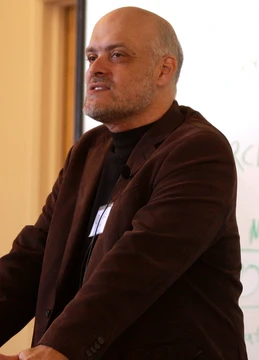
Carl Schmitt
German jurist and Nazi Party legal theorist.

via Wikipedia: Carl Schmitt · see source
Carl Schmitt (11 July 1888 – 7 April 1985) was a German jurist and political philosopher. An authoritarian conservative, he was noted as a critic of parliamentary democracy, liberalism, and cosmopolitanism. In 1933, Schmitt joined the Nazi Party and used his legal and political theories to provide ideological justification for the regime. He held various positions on Nazi councils, including the Prussian State Council and the Academy for German Law, and served as president of the National Socialist Association of Legal Professionals. By 1936, he had lost favour among senior Nazi officials and was removed from most of his official positions within the party. Schmitt and his work remain controversial for their association with Nazism.
- born
- 11 July 1888, Plettenberg, Westphalia, German Empire
- died
- 7 April 1985
- field
- Jurist and political philosopher
- nationality
- German
- known_for
- Critic of parliamentary democracy and liberalism; theory of the state of excepti
Verified Timeline
Lore & Background
Schmitt was born in Plettenberg, Westphalia, German Empire, to Roman Catholic parents from the German Eifel region. He studied law at the Friedrich Wilhelm University of Berlin, the Ludwig-Maximilians-Universität München, and the University of Strasbourg between 1907 and 1910, passing his first state law examination that same year. His 1910 doctoral thesis was titled *Über Schuld und Schuldarten* (On Guilt and Types of Guilt). In 1914, he obtained his habilitation at the University of Strasbourg with a thesis titled *Der Wert des Staates und die Bedeutung des Einzelnen* (The Value of the State and the Significance of the Individual). He volunteered for service with the Bavarian Army in February 1915 and served in the First World War, being discharged on 1 July 1919. Returning to civilian life, he embarked on an academic career that led to teaching positions at the Technical University of Munich (1920), the University of Greifswald (1921), the University of Bonn (1922), the Technical University of Berlin (1928), the University of Cologne (1933), and the Friedrich Wilhelm University of Berlin (1933–1945). Before his Nazi party involvement, Schmitt maintained many Jewish friends and colleagues. In 1932, he helped arrange for Leo Strauss to receive a grant from the Rockefeller Foundation but avoided communicating with Strauss after joining the Nazi Party. Schmitt was also close with the Eisler family, a Jewish family that supported him financially during an impoverished period as a student. He suspended his relationship with the Eisler family in 1933. While in Munich, Schmitt attended Max Weber's lectures, 'Politics as a Vocation', 'Science as a Vocation', and the General Economic History. In 1921, he published *Die Diktatur* (On Dictatorship), and in 1922, *Politische Theologie* (Political Theology). His most famous paper, 'Der Begriff des Politischen' ('The Concept of the Political'), was based on lectures at the Deutsche Hochschule für Politik in Berlin. In 1932, Schmitt was counsel for the Reich government in the case *Preussen contra Reich* (Prussia vs. Reich), which resulted in the de facto destruction of federalism in the Weimar Republic. On 31 January 1933, Schmitt remarked that with Adolf Hitler's appointment as Chancellor, 'one can say that "Hegel died."' The Nazis engineered the passage of the Enabling Act of 1933 in March. A legal opinion by Schmitt prevented a manoeuvre by Alfred Hugenberg from slowing the Nazi takeover, declaring that 'present government' referred to a 'completely different kind of government' that the Hitler cabinet had brought into existence. Schmitt joined the Nazi Party on 1 May 1933. Within days, he rejoiced in the burning of Jewish authors' 'un-German' and 'anti-German' writings and called for a much more extensive purge. From June 1933, he was in the leadership council of Hans Frank's Academy for German Law and chaired the Committee for State and Administrative Law. In July, Hermann Göring appointed him to the Prussian State Council, and in November he became the president of the Association of National Socialist German Jurists. By 1936, he had lost favour among senior Nazi officials and was removed from most of his official positions within the party.
Reader's Guide
Carl Schmitt's significance lies in his dual role as a sharp critic of liberal constitutionalism and as a legal theorist who provided ideological justification for the Nazi regime. His doctrine of the 'state of exception,' formulated in his 1921 work *The Dictatorship*, advocated for giving a state absolute power during crises and argued the law should not apply during times of emergency. Formulated 10 years before the 1933 Nazi takeover of Germany, Schmitt claimed that urgency justified special executive powers, suspension of the Rule of Law, and derogation of legal and constitutional rights. The Stanford Encyclopedia of Philosophy writes, 'Schmitt was an acute observer and analyst of the weaknesses of liberal constitutionalism and liberal cosmopolitanism. But there can be little doubt that his preferred cure turned out to be infinitely worse than the disease.' His ideas remain highly influential, with scholars arguing he has influenced modern governance in China and Russia, as well as various strands of modern American conservatism. Schmitt and his work remain controversial for their association with Nazism.
Did You Know?
- Schmitt's 1910 doctoral thesis was titled *Über Schuld und Schuldarten* (On Guilt and Types of Guilt).
- In 1932, Schmitt helped arrange for Leo Strauss to receive a grant from the Rockefeller Foundation, but avoided communicating with Strauss after joining the Nazi Party.
- On 31 January 1933, Schmitt remarked that with Adolf Hitler's appointment as Chancellor, 'one can say that "Hegel died."'
- Schmitt joined the Nazi Party on 1 May 1933 and within days rejoiced in the burning of Jewish authors' writings, calling for a much more extensive purge.
- By 1936, Schmitt had lost favour among senior Nazi officials and was removed from most of his official positions within the party.
Gallery

Frequently Asked Questions
Who is Carl Schmitt?
Carl Schmitt was a German jurist and political philosopher best known for his forceful critiques of parliamentary democracy, liberalism, and cosmopolitanism. He developed the influential concept of the state of exception and, after 1933, served as a legal theorist within the Nazi Party.
What are Carl Schmitt's main theoretical contributions?
His most discussed idea is the theory of the state of exception, which examines how sovereign authority operates when the normal legal order is suspended. He also argued that genuine political decision-making requires a clear friend-enemy distinction rather than the endless procedural negotiation he associated with liberal parliamentarism.
What was Carl Schmitt's role in the Nazi regime?
He joined the Nazi Party in 1933 and then drew on his legal and political frameworks to provide ideological justification for the regime's authoritarian measures. This entanglement remains the most controversial element of his legacy and the main reason his work is handled with caution in mainstream academic circles.
Why is Carl Schmitt still relevant to political theory today?
Scholars continue to trace his influence on modern governance, with some connecting his ideas to contemporary statecraft in China and Russia as well as to certain strands of American conservatism. His challenge to liberal assumptions about sovereignty and emergency powers keeps him a recurring figure in legal and political philosophy discussions.
When and where was Carl Schmitt born, and when did he die?
He was born on 11 July 1888 in Plettenberg, Westphalia, in the German Empire, and died on 7 April 1985. His long lifespan meant he outlived the regime he had helped justify by more than four decades.
More in Legal Scholars And Political Theorists 1-24
Related in Legal Scholars And Political Theorists
Links follow this subject's own source article.
Elsewhere in the Legal Scholars And Political Theorists universe
Spotted an error? Know more?
This is a living reference — every entry is fact-audited, and reader corrections feed straight into our audit queue. Suggest an edit · See this site's audit record